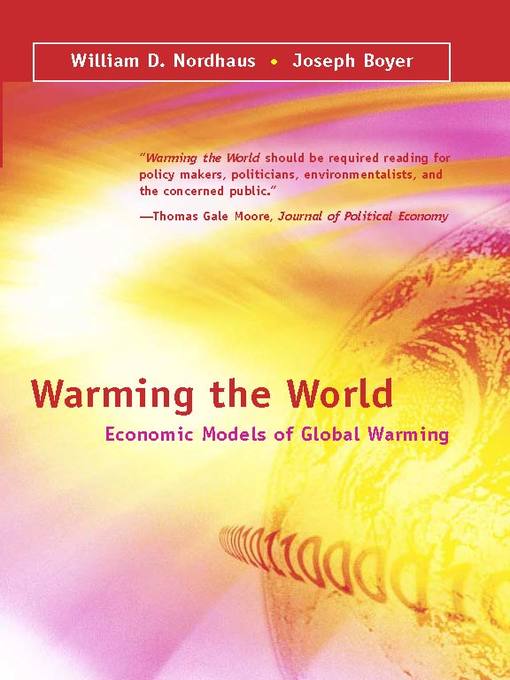
Humanity is risking the health of the natural environment through a myriad of interventions, including the atmospheric emission of trace gases such as carbon dioxide, the use of ozone-depleting chemicals, the engineering of massive land-use changes, and the destruction of the habitats of many species. It is imperative that we learn to protect our common geophysical and biological resources. Although scientists have studied greenhouse warming for decades, it is only recently that society has begun to consider the economic, political, and institutional aspects of environmental intervention. To do so raises formidable challenges of data modeling, uncertainty, international coordination, and institutional design.Attempts to deal with complex scientific and economic issues have increasingly involved the use of models to help analysts and decision makers understand likely future outcomes as well as the implications of alternative policies. This book presents in detail a pair of models of the economics of climate change. The models, called RICE-99 (for the Regional Dynamic Integrated model of Climate and the Economy) and DICE-99 (for the Dynamic Integrated Model of Climate and the Economy) build on the authors' earlier work, particularly their RICE and DICE models of the early 1990s. They can help policy makers design better economic and environmental policies.
- Available now
- Banned Books Week: Always Avaiable Titles
- California Authors
- Most popular
- At the End of All Things--Complete Fantasy Series
- Crime Queens of the Golden Age
- Try something different
- True Adventure Stories
- Bookish Romance
- See all ebooks collections
- Audiobooks for the Drive to Las Vegas
- Audiobooks for the Drive to Palm Springs
- Audiobooks for the Drive to San Francisco
- Available now
- Audiobooks for the Whole Family
- Uplifting Listens
- Most Popular Audio Between 1 and 3 Hours
- New audiobook additions
- Listen While You Run: Audiobooks for Workouts
- Try something different
- Most popular
- See all audiobooks collections