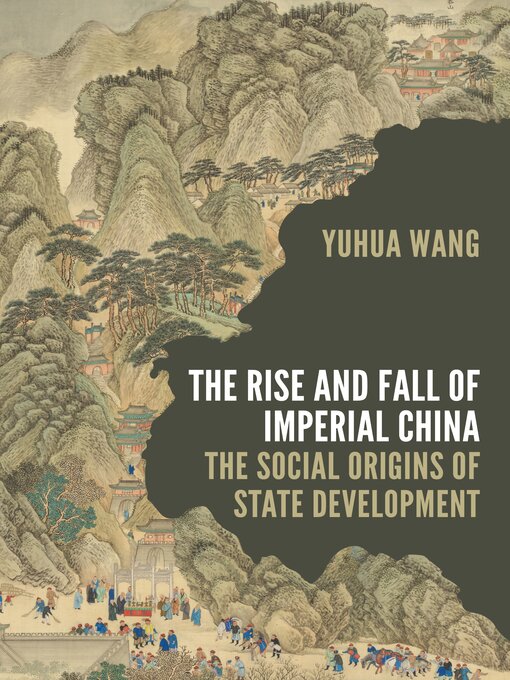
How social networks shaped the imperial Chinese state
China was the world's leading superpower for almost two millennia, falling behind only in the last two centuries and now rising to dominance again. What factors led to imperial China's decline? The Rise and Fall of Imperial China offers a systematic look at the Chinese state from the seventh century through to the twentieth. Focusing on how short-lived emperors often ruled a strong state while long-lasting emperors governed a weak one, Yuhua Wang shows why lessons from China's history can help us better understand state building.
Wang argues that Chinese rulers faced a fundamental trade-off that he calls the sovereign's dilemma: a coherent elite that could collectively strengthen the state could also overthrow the ruler. This dilemma emerged because strengthening state capacity and keeping rulers in power for longer required different social networks in which central elites were embedded. Wang examines how these social networks shaped the Chinese state, and vice versa, and he looks at how the ruler's pursuit of power by fragmenting the elites became the final culprit for China's fall.
Drawing on more than a thousand years of Chinese history, The Rise and Fall of Imperial China highlights the role of elite social relations in influencing the trajectories of state development.
- Available now
- Banned Books Week: Always Avaiable Titles
- California Authors
- Most popular
- At the End of All Things--Complete Fantasy Series
- Crime Queens of the Golden Age
- Try something different
- True Adventure Stories
- Bookish Romance
- See all ebooks collections
- Audiobooks for the Drive to Las Vegas
- Audiobooks for the Drive to Palm Springs
- Audiobooks for the Drive to San Francisco
- Available now
- Audiobooks for the Whole Family
- Uplifting Listens
- Most Popular Audio Between 1 and 3 Hours
- New audiobook additions
- Listen While You Run: Audiobooks for Workouts
- Try something different
- Most popular
- See all audiobooks collections