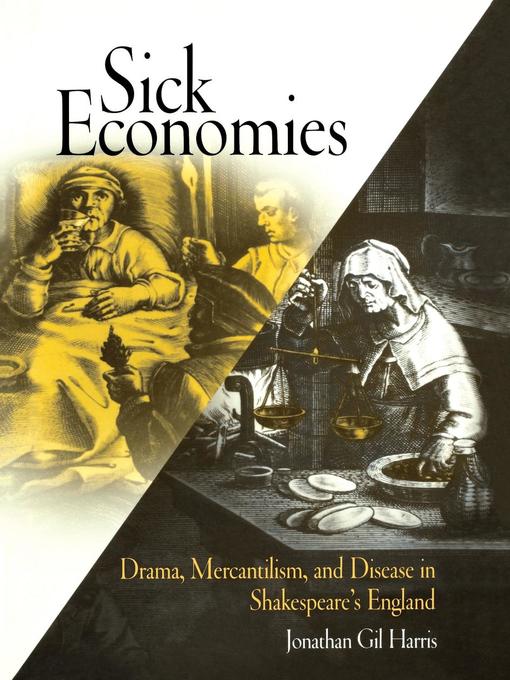
From French Physiocrat theories of the blood-like circulation of wealth to Adam Smith's "invisible hand" of the market, the body has played a crucial role in Western perceptions of the economic. In Renaissance culture, however, the dominant bodily metaphors for national wealth and economy were derived from the relatively new language of infectious disease. Whereas traditional Galenic medicine had understood illness as a state of imbalance within the body, early modern writers increasingly reimagined disease as an invasive foreign agent. The rapid rise of global trade in the sixteenth century, and the resulting migrations of people, money, and commodities across national borders, contributed to this growing pathologization of the foreign; conversely, the new trade-inflected vocabularies of disease helped writers to represent the contours of national and global economies.
Grounded in scrupulous analyses of cultural and economic history, Sick Economies: Drama, Mercantilism, and Disease in Shakespeare's England teases out the double helix of the pathological and the economic in two seemingly disparate spheres of early modern textual production: drama and mercantilist writing. Of particular interest to this study are the ways English playwrights, such as Shakespeare, Jonson, Heywood, Massinger, and Middleton, and mercantilists, such as Malynes, Milles, Misselden, and Mun, rooted their conceptions of national economy in the language of disease. Some of these diseases—syphilis, taint, canker, plague, hepatitis—have subsequently lost their economic connotations; others—most notably consumption—remain integral to the modern economic lexicon but have by and large shed their pathological senses.
Breaking new ground by analyzing English mercantilism primarily as a discursive rather than an ideological or economic system, Sick Economies provides a compelling history of how, even in our own time, defenses of transnational economy have paradoxically pathologized the foreign. In the process, Jonathan Gil Harris argues that what we now regard as the discrete sphere of the economic cannot be disentangled from seemingly unrelated domains of Renaissance culture, especially medicine and the theater.
- Available now
- Banned Books Week: Always Avaiable Titles
- California Authors
- Most popular
- At the End of All Things--Complete Fantasy Series
- Crime Queens of the Golden Age
- Try something different
- True Adventure Stories
- Bookish Romance
- See all ebooks collections
- Audiobooks for the Drive to Las Vegas
- Audiobooks for the Drive to Palm Springs
- Audiobooks for the Drive to San Francisco
- Available now
- Audiobooks for the Whole Family
- Uplifting Listens
- Most Popular Audio Between 1 and 3 Hours
- New audiobook additions
- Listen While You Run: Audiobooks for Workouts
- Try something different
- Most popular
- See all audiobooks collections