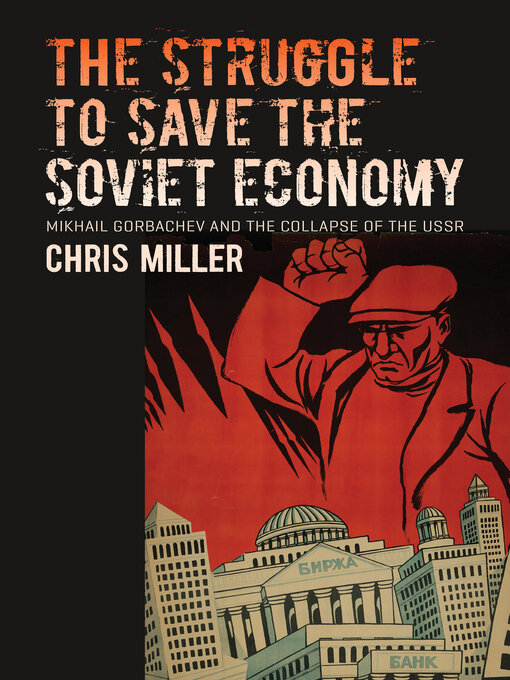
For half a century the Soviet economy was inefficient but stable. In the late 1980s, to the surprise of nearly everyone, it suddenly collapsed. Why did this happen? And what role did Soviet leader Mikhail Gorbachev’s economic reforms play in the country’s dissolution? In this groundbreaking study, Chris Miller shows that Gorbachev and his allies tried to learn from the great success story of transitions from socialism to capitalism, Deng Xiaoping’s China. Why, then, were efforts to revitalize Soviet socialism so much less successful than in China?
Making use of never-before-studied documents from the Soviet politburo and other archives, Miller argues that the difference between the Soviet Union and China — and the ultimate cause of the Soviet collapse — was not economics but politics. The Soviet government was divided by bitter conflict, and Gorbachev, the ostensible Soviet autocrat, was unable to outmaneuver the interest groups that were threatened by his economic reforms. Miller’s analysis settles long-standing debates about the politics and economics of perestroika, transforming our understanding of the causes of the Soviet Union’s rapid demise.
- Available now
- Banned Books Week: Always Avaiable Titles
- California Authors
- Most popular
- At the End of All Things--Complete Fantasy Series
- Crime Queens of the Golden Age
- Try something different
- True Adventure Stories
- Bookish Romance
- See all ebooks collections
- Audiobooks for the Drive to Las Vegas
- Audiobooks for the Drive to Palm Springs
- Audiobooks for the Drive to San Francisco
- Available now
- Audiobooks for the Whole Family
- Uplifting Listens
- Most Popular Audio Between 1 and 3 Hours
- New audiobook additions
- Listen While You Run: Audiobooks for Workouts
- Try something different
- Most popular
- See all audiobooks collections